

I stopped on a word.
I had written it without thinking — the way you reach for a tool you’ve used your whole life — and then something made me stop and look at it again. I stared at it, sitting right there in the sentence. For the briefest moment I was no longer sure it meant what I had spent my life assuming it meant.
I picked up my phone and looked it up.
In the half-second before I did, I felt a flush of something — as if I should know this, as though having to stop to verify meant the rest of the thought was already slipping through my fingers.
I looked it up anyway.
The word was synthesize.
The first thing that hit me was chemistry. Compounds built from simpler parts, the synthesis of a molecule. My heart sank a little. I had wanted the word for something else, a meaning I’d felt entirely sure of until I looked at the word as I typed it, and here it was, belonging to a chemist and a laboratory.
I scrolled. Further down, under the chemistry:
Separate elements — things, substances, even ideas — combined into a single, unified whole.
There. That was the one. The meaning I had carried without being able to prove I hadn’t invented it.
With that moment came the thing I do this for. A small rush. Always with an arc like a firework: the word goes up, explodes, hangs for a second or two, and falls in sparks. The rush has a shape and a tempo, so fast it’s over almost before it starts. The sentence I’d been building clicked into place around it, finding its perfect center of gravity. Because words are like physics. Gravity does not forgive. A sentence is like a chair: four legs on the floor is stable, functional, boring. Leaning back — testing, playing with the edge of balance and your own weight — is thrilling. The right words hold the reader at that edge, suspended. But just one word carrying not quite the right meaning shifts that center a millimeter past the point of no return, into the moment of panic everyone knows: that sudden weightlessness, balance lost, helpless.
Nothing stops that fall. The reader is lost. And the idea stops.
I.
I have been doing this for as long as I can remember.
Not with the phone — the phone is new. The reaching. The stopping on a word, the need to be sure of it, the small fear of being caught not knowing. I learned that reach before I learned almost anything else, and I learned it in a specific place, which I can still smell.
Take away the phone in my hand. Take away the glowing rectangle that holds every word at once. Take away the network it pulls them from — unbuild it, strand by strand, until the very idea of it is gone. Take away the computers that came before it, the ones named after fruit, the beige boxes with green letters on black screens. Keep going back, past all of it, to a time before anyone I knew had touched a machine that could think with them at all.
What’s left is a boy in a library, and a dictionary made of paper, and all the time in the world.
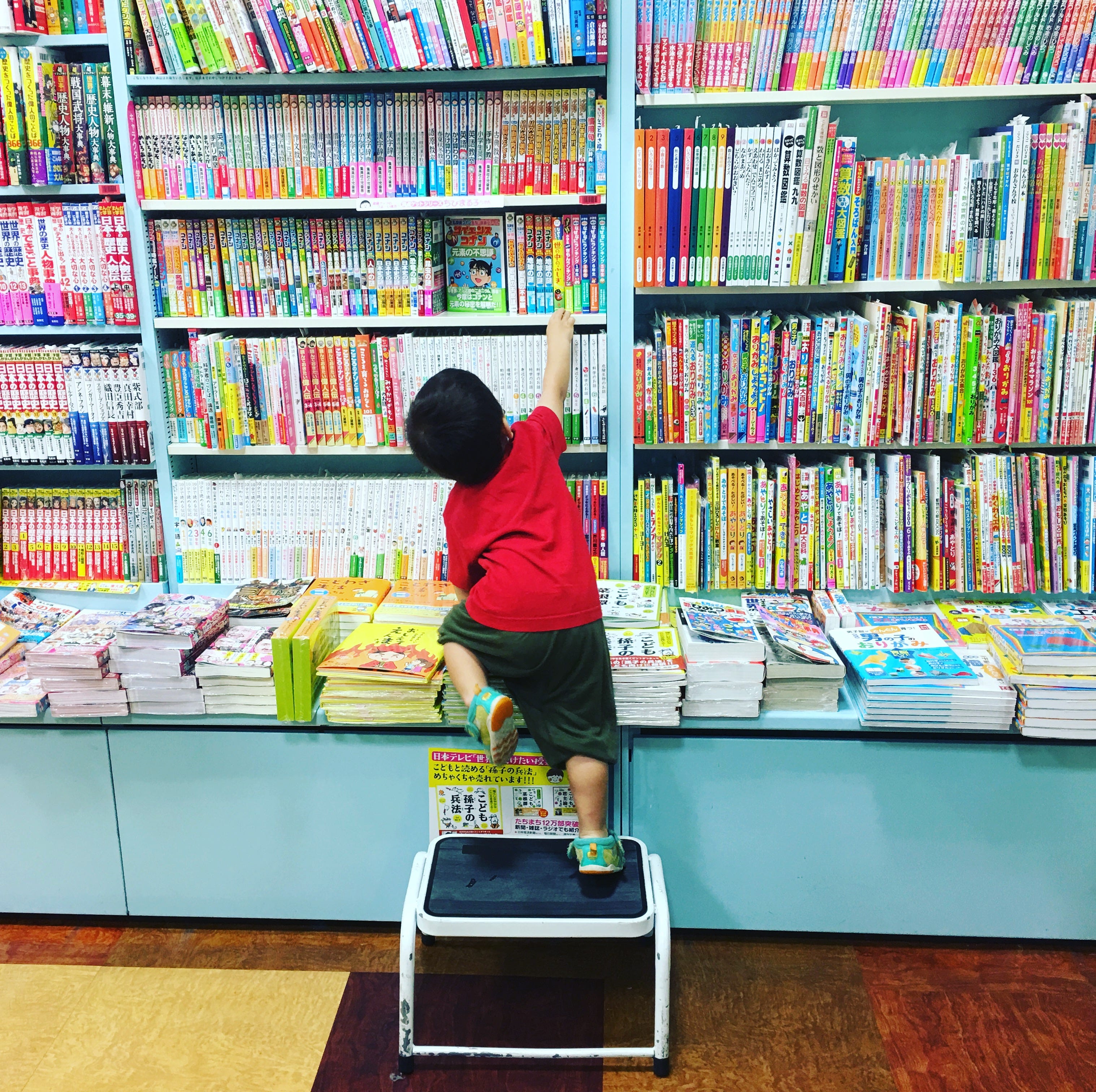
I went there because it was cool through the long summer, and because there was nowhere else to be, and because the books were free. I had a place: a stretch of wall between two aisles where I’d set down my backpack, a bottle of water, a baggie of trail mix, and make camp for the day. I’d find a book and read until a word stopped me, a word I didn’t know sitting in the path like a locked door, and the reading couldn’t go on until I dealt with it.
So I’d leave my book, cracked open against the floor to mark the page, and go to the dictionary — the enormous, heavy kind, on its own stand in the middle of the library, lying open, welcoming anyone who passed. I’d find the word. The definition would have other words in it I didn’t know, so I’d chase those too, and those would open onto others, until an hour had gone and I’d forgotten which word had sent me to begin with. The open book on the floor was how I found my way back. I’d return, start the sentence again, reach the word that had stopped me — and this time I knew it. And it felt good. Like the burst of a roman candle in summer. I can still feel how good it felt.
I didn’t know it then, but I was learning the thing that has mattered most to my life since. Not the words. The reaching for them. Each one I ran down was a thing some human being, somewhere, sometime — maybe a thousand years ago — had shaped out of a breath and a need into a sound that could carry a meaning across to another mind. And the more of them I caught, the more the next book opened to me, and the one after that, until somewhere in there, without a day I could point to, I had become a reader. And a reader, given enough years, becomes something stranger and more useful: someone who can recognize things. Who can feel, three pages in, what a story is going to ask of him. Who hears the rhyme a new thing makes with an old one.
It happened to me again in college, in a language built backward from the one I’d grown up in.
English I had climbed from the bottom: letters made sounds, sounds made words, words made sense. Japanese ran the other way. Each character was a picture made up of smaller, interlocking pictures. A tree, a mouth, a hand, fitted into a single glyph that could mean several things at once, depending on what stood beside it and which one you’d chosen to begin with.
There was no sounding it out. You could not climb up to the meaning. You had to take it apart.
So I took each apart. A different dictionary, a different table, the same boy, now a young man, doing the same thing: running a character down into its pieces, chasing the pieces, an hour gone before I surfaced. And somewhere in there I understood that the language had never been the destination. It was only the path. What I was walking toward, both times, was the understanding waiting on the other side of the word.
II.
That boy is a father now, and half a world away from that library.
The years came back the way they’d gone, only in reverse: the machines arriving, the network spun back into being, the glowing rectangle set again in my hand. I now live in the language I once took apart. My sons dream in it. And I still stop on words. I still feel the small fear of being caught not knowing. The reach never left me; all that changed was what I could reach for.
Because the dictionary is different now. It is not a book on a stand, or even a screen I scroll. It holds every word at once — and more than that, it answers. I can hand it the shape of a thing I can’t name and it will hand me the name. I can ask it whether a word I half-remember from a novel I read as a boy was ever really used the way I remember, and it will read the whole of that writer’s work in the time it takes me to finish this sentence.
But speed was never the point. The boy in the library wasn’t chasing words to own more of them. He was chasing the thing on the far side of them — the understanding that, once it arrives, changes what you can make.
Because a definition belongs to the dictionary. A word understood is a word you can use. It goes down on the page the way a brushstroke goes down on canvas — not for its own sake, but to paint, stroke beside stroke, an image that was not there before. And when the strokes are right, the reader is no longer reading. The reader is somewhere. Inside the idea. Inside the room. Inside the person who is not them. Carried there, across a gap, by marks on a page that a stranger arranged in the right order.
That is the only thing I have ever been trying to do. Everything else — the reaching, the dictionaries, the hours on the floor between the aisles — was always in service of that one crossing.
III.
As a boy I would lie awake, listening to my father’s guitar come faintly through the bedroom wall. He practiced for hours, late into the night. Not always a whole piece. Pieces of the piece. Scales. Sometimes a single note — the same note, over and over, long past the point where I could tell what he was listening for.
I didn’t know it then, but he was taking apart music written hundreds of years before he was born — down to its smallest elements. Simply playing the piece as written would have been like reading a script out loud. So the nights in his makeshift studio in the garage were only half of it. The other half he spent in a library — days, sometimes months — with the composer’s journals, the diaries, the reviews, the private letters, looking for what all that practicing was for. Where did the piece take the people who first heard it? What did it paint for them?
What I could not see through the wall, I could hear: the ache. He ached over every note — its speed, its weight, its feel, the way it would land in a listener — because each note was its own brushstroke, and the strokes, laid right, could carry a room full of strangers to some version of a feeling a man had in a different life, a different century, and left behind in the only form that could survive the trip.
A gift, delivered by a messenger who spent his whole life learning to deliver it.
I understand the ache now.
Because the word I stopped on — the one that sent me to the dictionary and then, somehow, forty years down into a library and back — was synthesize.
I stopped on it because I was about to build this essay on top of it, and gravity does not forgive. Every sentence since has leaned on that one word.
You have been sitting in the chair this whole time, each paragraph leaning you back a tiny bit more, just to that edge. And the only thing holding you was a meaning from a memory.
It held. Separate elements, combined into a single, unified whole.
A boy on a floor between two aisles. A young man taking a glyph apart at a table. A father’s guitar coming faintly through a bedroom wall. A dictionary that answers. Separate elements — none of them, alone, an essay. The combining happened where it has always happened: not on the shelf, not on the stand, not on the screen. In the reaching mind. Mine as I wrote this. Yours as you read it — because you have been doing it all along, fitting these pieces into a whole I never assembled for you.
You did.
And not one of the words was mine. Every word here was shaped by some human being, somewhere, sometime, out of a breath and a need — the same words that waited in the enormous dictionary on its stand, and that wait in the one that answers me now. The new dictionary holds every word at once because it is made of every word: everything we ever wrote down, the whole long human reach, bound in one place. When I hand it the shape of something I cannot name, I am not stepping outside the chain of people who made these words. I am standing as deep inside it as a person can stand.
My father delivered a gift that was never his — pieces left behind by men long dead, carried across centuries, even into a room where a boy lay listening. I have spent my life learning the same craft with words. This essay is the delivery. Every sentence in it was reached for, stopped on, checked, and owned — because the dictionary that answers took away the last excuse for doing anything less.
Nowhere to hide. It turns out that was the gift.
— JC